This article reflects the timeline Revenue has published as of September 2026. Timelines like this can change, so check Revenue's VAT Modernisation page before making decisions, and talk to your accountant about your own situation.
What is e-invoicing?
In everyday speech, "e-invoice" means any invoice sent by email. Revenue means something narrower. Under the new rules an e-invoice is a structured data file, in the European standard format known as EN 16931, that accounting systems can read automatically. It is typically sent over the Peppol network, which Irish public bodies already use to receive invoices from suppliers.
That means a PDF invoice attached to an email is not an e-invoice for these purposes, and neither is a scan of a paper invoice. Revenue has been clear that the changes are about how invoices are issued and reported, not about VAT rates or how much tax is due.
The timeline, phase by phase
| Phase | Date | Who it covers | What changes |
|---|---|---|---|
| 1 | 1 November 2028 | VAT-registered large corporates managed by Revenue's Large Corporates Division | Must issue structured e-invoices for domestic business-to-business sales and report invoice data to Revenue in close to real time |
| 1 | 1 November 2028 | All businesses in Ireland | Must be able to receive structured e-invoices |
| 2 | November 2029 | All remaining VAT-registered businesses that make supplies to businesses in other EU countries | Must issue e-invoices for their domestic business-to-business sales too |
| 3 | July 2030 | Cross-border EU business-to-business trade | Full EU "VAT in the Digital Age" (ViDA) rules apply |
Revenue describes the first phase as affecting a small number of businesses that are best placed to adapt. The phased approach is meant to let the system bed in before the wider EU requirements arrive in 2030.
Does it affect a small business with an invoice book?
Work through three questions.
1. Are you a large corporate?
If your tax affairs are handled by Revenue's Large Corporates Division, you will already know, and you are in Phase 1. Most readers of this article are not.
2. Do you sell to VAT-registered businesses in other EU countries?
If yes, Phase 2 in November 2029 is the date to plan for. From then, businesses that make intra-EU supplies are expected to issue e-invoices for their business-to-business sales within Ireland as well. Talk to your accountant or software provider well ahead of that date. Sales to private individuals are not part of these business-to-business rules.
3. Do you sell only within Ireland, or mainly to the public?
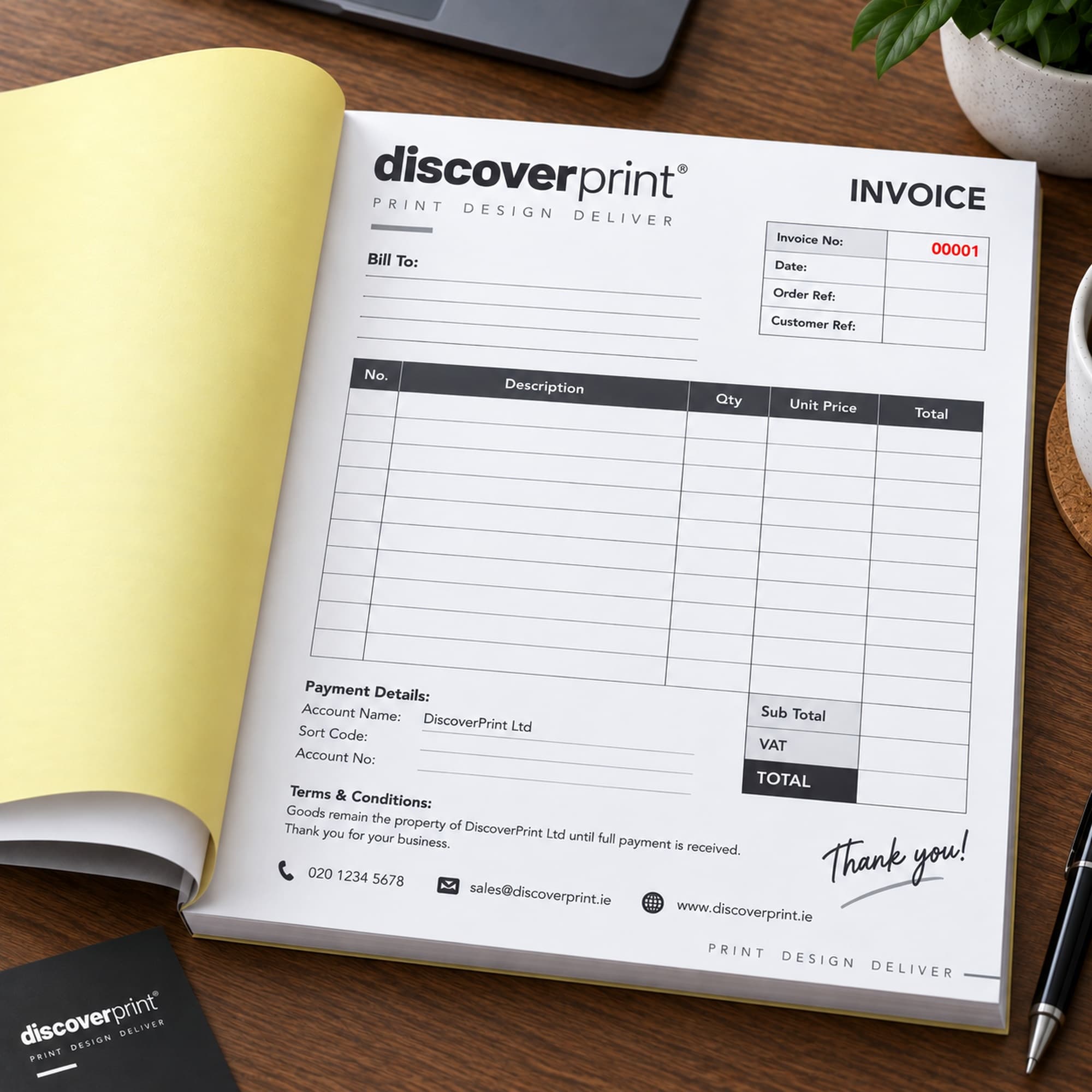
Then none of the published phases require you to issue e-invoices. Sales to private individuals are not part of the business-to-business rules at all. A paper invoice, written in a numbered book and containing every detail Revenue requires, remains valid. Our guide Are handwritten invoices legal in Ireland? lists those details.
The change every business should prepare for
From November 2028, all businesses in Ireland are expected to be able to receive structured e-invoices. If you buy from a large supplier, such as a builders' providers chain, a fuel company or a wholesaler, their invoices to you may start arriving in the new format.
For most small businesses this will be handled by accounting software rather than by anything you do yourself. The sensible step now is to ask your accountant or software provider how they will support receiving e-invoices, well before 2028.
Why paper invoice books are still worth having
Even businesses that move to software keep a paper book for good reasons:
- On-the-spot invoicing. The customer gets the invoice before you leave, which usually means faster payment.
- No signal needed. Rural call-outs, basements and building sites often have no coverage.
- Backup. When software, a tablet or a card machine fails, a numbered paper book keeps trading going. We cover this in What should you do when the card machine or till goes down?
Keeping paper records alongside the new system
Nothing in the e-invoicing plan changes the existing record-keeping rules for paper. Revenue asks that invoices issued on paper are kept in paper form and within the State, generally for six years. If you use a paper book, keep the finished books. We explain how in How long do you need to keep invoice copies in Ireland?
Numbered paper invoice books for businesses outside the e-invoicing phases
If your business is outside the current phases, a numbered paper invoice book is still a simple, compliant way to invoice. Discoverprint's personalised invoice books are printed with your business details, VAT number, headings and sequential numbers, in A4, A5, A6 or DL, duplicate or triplicate, with free design and free delivery anywhere in Ireland. See the full NCR books range.