Free delivery across Ireland on all ordersTrack my orderCreate an account

First order offer
Join our email list and we will send you a code to use in the basket.*
* €10.00 off your first order over €50.00 ex VAT. One use per customer. Valid for 90 days.
· Small business
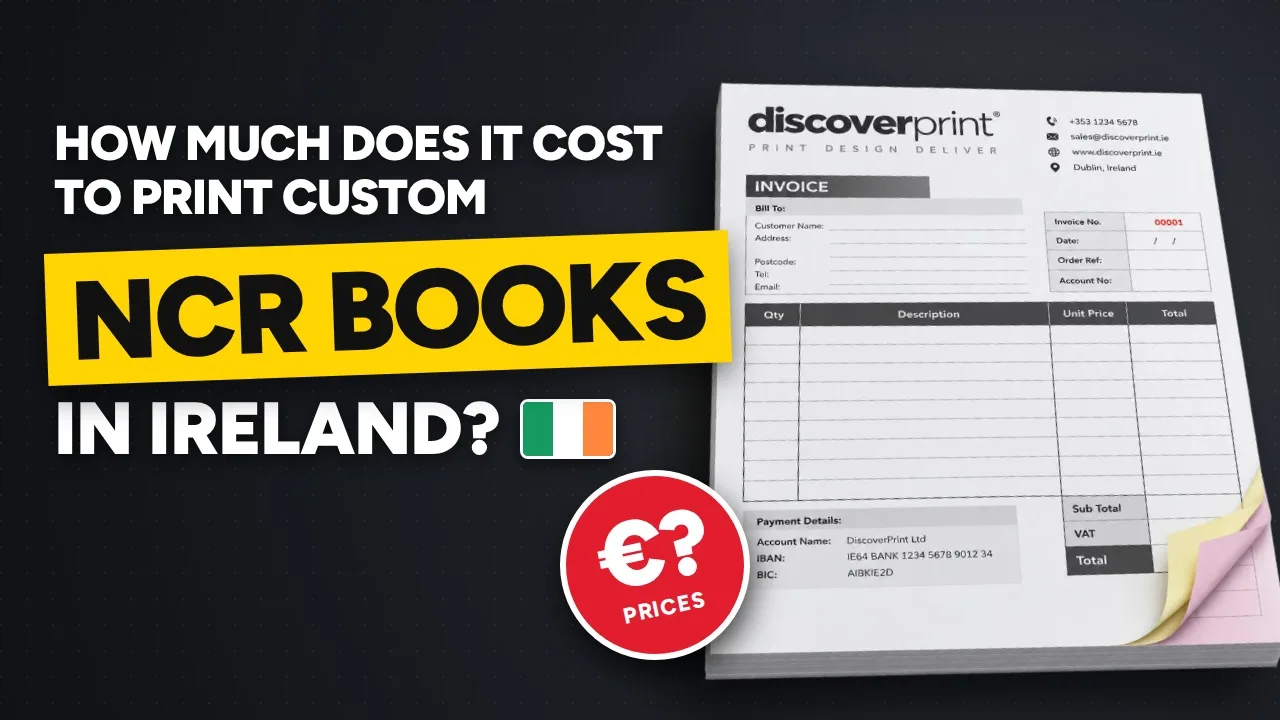
Printing custom NCR books in Ireland comes down to three costs: design, print and delivery. Most printers only show the print cost and add the rest later. This guide gives our live prices for A4 and A5 duplicate books at 5, 10, 20 and 50 books, the cost per book and per invoice, and what is included in each price.
Read article· Small business
Operators of commercial vehicles in Ireland must make sure a walk-around check is done before a vehicle goes on the road, with a system for recording defects. This guide covers what the RSA's CVRT guidance says, what a check sheet and defect report should include, how long to keep them, and how a numbered paper book supports the system.
Read article· Guides
A delivery note travels with the goods and confirms what was sent. It is not an invoice, but it is part of your sales records and often the document that gets an invoice paid. This guide covers what a delivery note should show, how many copies you need, and when a pad works better than a book.
Read article· Small business
A good order pad gets the right food to the right table and the right allergy note to the kitchen. This guide covers the size that suits waiting staff, why two-part pads help, what to print on the form, and how the pad fits alongside the written allergen information Irish food businesses must provide.
Read article· Guides
A glued NCR pad seems to do something clever: each set holds together, but lifts cleanly off the next. The trick is a special adhesive and the way carbonless paper is coated. This guide explains how it works, why ordinary glue fails, and how to use and separate pads without tearing the copies.
Read article· Guides
NCR pads and NCR books use the same carbonless paper but work in opposite ways. In a book, one copy stays bound. In a pad, the whole set tears off and the copies are filed separately. This guide explains the difference, the uses each suits best, and how to choose.
Read article· Small business
Card terminals, tills and broadband all fail sooner or later, usually on the busiest day. A numbered paper book and a short set of rules keep you trading and keep the records straight. This guide sets out the plan, what to record for each sale, what never to write down, and how to enter the sales afterwards.
Read article· Small business
Cash is still a big part of club and charity income in Ireland: subs, lotto, raffles, collections and events. This guide sets out a simple, well-tested way to record it, based on the controls Irish charities are advised to use, with numbered receipts at its centre.
Read article· Small business
There is no general rule in Irish consumer law that a business must hand every customer a receipt. There are rules about VAT invoices for business customers, and receipts are the easiest proof of purchase when something goes wrong. This guide sets out what the law requires, what the CCPC says about proof of purchase, and why giving receipts protects the business as much as the customer.
Read article· Guides
A receipt book gives the payer proof of payment and gives you a numbered copy of every payment you took. This guide explains how the carbonless copy works, how to fill in each receipt, how many receipts are in a book, and the habits that stop receipts being questioned later.
Read article· Guides
Invoice books and receipt books are made the same way. The difference is the job the form does: an invoice asks to be paid, a receipt confirms payment arrived. This guide explains when you need each, what each should show for Irish customers, and when a single book can cover both.
Read article· Guides
Proof of delivery is the signed record that goods reached the customer. It is what settles arguments about what arrived, when and in what condition. This guide covers what a delivery docket should show, how to handle shortages and damage at the door, and when paper still beats a handheld device.
Read article· Small business
Most disputes between garages and customers come down to one question: what did the customer agree to? A good job sheet answers it. This guide covers what an Irish garage job sheet should record, what the CCPC tells motorists to expect, and why many garages use a three-part carbonless job sheet.
Read article· Guides
After duplicate and triplicate come quadruplicate, with four parts, and quintuplicate, with five. This guide explains the terms, the trade-offs of four-part NCR books, the copy colours you will usually see, and simpler alternatives that often do the same job.
Read article· Guides
A triplicate docket system uses one handwritten, three-part form so the customer, the person on the road and the office all get the same record at the same moment. This guide explains how the copies flow, how to label them, and the simple daily check that makes the system work.
Read article· Guides
Duplicate means two copies of every form, triplicate means three. The real question is whether the third copy has somewhere to go. This guide explains the difference, why triplicate books hold fewer sets, which businesses genuinely need three copies, and how to decide.
Read article· Small business
Customers in Ireland are told by the CCPC to ask for a quote, not an estimate, and to get it in writing. That shapes how tradespeople should price jobs. This guide explains the difference between a quote, an estimate and an invoice, what each should include, and how to use a quotation book alongside an invoice book.
Read article· Small business
Ordering invoice books one at a time costs more and risks running out mid-job. Ordering five years' worth wastes paper. This guide gives a simple formula and a ready-reckoner table to work out a year's supply, with advice for businesses running more than one van or counter.
Read article· Guides
Spoiled invoices happen to everyone. What matters is what you do next. This guide explains how to cancel an invoice that has not been issued, what Revenue requires once the customer has it, what a credit note must show, and the habit that causes the most trouble: tearing the page out.
Read article· Small business
Revenue generally expects business records, including the copies in your invoice book, to be kept for six years. This guide explains when that period starts, when it runs longer, why invoices you issued on paper should stay on paper, and a simple way to store used books so they are easy to find.
Read article· Guides
A duplicate invoice book makes two copies of every invoice you write: one for the customer and one for your records. This guide explains how it works, how many invoices a book holds, how to choose a size, and the details that separate a good book from one that causes problems.
Read article· Small business
Irish law gives businesses real rights when other businesses pay late, but most small firms never use them. This guide explains the default 30-day rule, when longer terms are allowed, how statutory interest and fixed compensation work, and what payment terms to print on your invoices so there is no argument.
Read article· Small business
Sole traders in Ireland invoice in much the same way as companies, with two big differences: whether you are VAT registered, and whether you trade under your own name. This guide covers both, with the current VAT thresholds, what a non-VAT invoice should show and what changes once you register.
Read article· Guides
Filling in an invoice book takes a minute once you know the order. This guide goes box by box through a typical Irish invoice book, shows how to work out VAT, explains which copy goes where and what to do when you make a mistake.
Read article· Small business
Revenue is introducing electronic invoicing in three phases from November 2028. The first phase covers only large corporates. This guide sets out the timeline, explains what counts as an e-invoice, and answers the question most small businesses are asking: can I keep writing paper invoices?
Read article· Guides
A handwritten invoice is as valid in Ireland as a printed or emailed one, as long as it contains the details Revenue requires. This guide lists those details, explains when you must issue a VAT invoice and when you do not, covers the 15-day rule and the €100 simplified invoice, and walks through a completed example.
Read article· Guides
Carbonless paper had a genuine health problem in the 1950s and 1960s, when PCBs were used in the ink. That ended in the early 1970s. This guide explains what changed, whether modern carbonless paper is safe to handle, how it differs from thermal till receipts, and how to dispose of old invoice books in Ireland without breaking the record-keeping rules.
Read article· Guides
Faint copies are rarely caused by old paper. The usual culprits are the pen, the pressure, the surface and a missing writing shield. This guide explains each one, what really shortens the life of carbonless paper, and how to store books and copies so they stay readable for years.
Read article· Guides
Office printers can print carbonless paper, but only the right grade, in the right sequence, and without numbering, perforation or binding. This guide explains what goes wrong, when printing your own forms makes sense, and when a printed NCR book is the better buy.
Read article· Guides
NCR paper copies handwriting through pressure, not carbon. This guide explains the coatings inside every set, why the sheets must be in the right order, and how carbonless paper differs from old carbon paper and from the thermal paper used in card machines.
Read article· Guides
In Ireland a docket book is a numbered book of carbonless forms used to record a sale, a job or a delivery at the moment it happens. This guide explains what a docket is, what belongs on one, and how docket, invoice and receipt books differ so you order the right one.
Read article· Guides
Yes. You do not need a design file, a designer or a minimum order of thousands. Here is exactly what we need and what happens next.
Read article· Guides
Stationery shop, office supplier or print shop. What each option gives you, what it does not, and what to check before you order.
Read article· Guides
Five things move the price, and quantity moves it most. How to read a quote properly and what to watch for when you compare two of them.
Read article· Small business
Paper invoice books have not gone away, and it is not nostalgia. Here is what they still do better, and where software wins instead.
Read article· Small business
You hand one over at the end of every job. That makes it one of the few pieces of print a customer is guaranteed to look at, and to keep.
Read article· Guides
Every set in the book carries its own number, in order, printed before you ever write on it. Here is what that is for and how to choose where yours starts.
Read article· Guides
Carbonless paper copies what you write onto the sheet underneath without a sheet of carbon in between. Here is how it works and where it is still the right choice.
Read article· Guides
Bleed, CMYK, dpi and the difference between litho and digital, explained in plain words so you can brief a printer without guessing.
Read article· Guides
How brochures are counted, which fold suits which job, and what belongs on each panel once it is folded.
Read article· Guides
A checklist of what belongs on a letterhead, including the details Irish companies are legally required to show, and what only gets in the way.
Read article· Design
Sometimes. It depends on whether the platform is where your work actually lives, and on whether you can do it without wrecking the layout.
Read article· Guides
Grams per square metre, and a plain list of what each common weight feels like in the hand and what it is used for.
Read article· Small business
A pad sits on someone's desk for weeks with your name on it. Five ways to make that worth more than the paper.
Read article· Small business
The print a small business actually needs, in the order worth buying it. You do not need all of this on day one.
Read article· Guides
Every common size in millimetres, and an honest view of which one suits a letterbox drop, a counter, a noticeboard or a hand.
Read article· Design
None of these need a budget. All of them are the difference between looking new and looking established.
Read article· Small business
They reach a street rather than an algorithm, they cannot be blocked, and they cost very little. Here is what makes the difference between a run that works and one that goes straight in the bin.
Read article· Design
Two colours, written down properly, used the same way everywhere. Most of the work is in the writing down.
Read article· Small business
A4 buys you room to itemise. Whether that is worth the extra size depends on how you work, not on which is better.
Read article· Design
85mm by 55mm, plus the bleed and safe margins that decide whether your card comes back looking right.
Read article· Guides
You can build a decent letterhead in an afternoon with tools you already have. Here is how, and here is where doing it yourself stops paying.
Read article· Design
Free tools will get you a long way. The difference between a card that looks designed and one that looks made is in about six decisions.
Read article