Can you bin a full invoice book once the figures are in the accounts? The short answer is no. Here is why, and how to store the books without them taking over the office.
When does the six years start?
The period runs from the date of the latest transaction the record relates to. For a single invoice book that covers January to April 2026, the clock for that book effectively starts from the last invoice in it. In practice, most businesses keep records by tax year and destroy nothing until the whole year is more than six years old.
When do you keep records for longer?
Revenue lists situations where records must be kept for six years or until the matter is finalised, whichever is later:
- you have made a claim under VAT law
- you have appealed to the Tax Appeals Commission
- the period is under enquiry or investigation by Revenue
There are also longer periods for certain property transactions. If any of these apply, speak to your accountant before destroying anything.
Why paper invoices should stay on paper
Revenue's guidance is specific: store invoices you issued on paper in paper form. The copy in your invoice book is the record of an invoice you issued on paper, so the book is the record.
That is different from invoices you receive. Revenue has allowed purchase invoices and other documents received from suppliers to be stored electronically, provided certain conditions are met. So a scan of a supplier's invoice may be acceptable, while a scan of your own invoice book is a convenience copy, not a replacement.
Revenue also asks that paper records are kept within the State. If you store records with a relative abroad or in a storage unit outside Ireland, that needs Revenue's agreement.
What counts as a record?
More than you might think. For sales, Revenue lists invoices to registered customers, sales dockets, sales receipts, till rolls, delivery notes, a cash book and bank statements, among others. So your docket books, receipt books and delivery note pads all count, not only your invoice book. If you are not sure what a docket is in this sense, What is a docket book, and how is it different from an invoice or receipt book? explains it.
Revenue also points out that keeping documents is not the same as keeping proper books. The invoices, dockets and receipts are the "linking documents" that support your accounts. You still need the accounts themselves.
What if you do not keep them?
Revenue's guidance refers to a penalty of €3,000 for failing to keep records or linking documents for a tax year or accounting period. More practically, without records you cannot back up your figures if Revenue asks, and your customers cannot rely on you for copies if they lose theirs.
A simple system for storing used invoice books
- Label the cover of each finished book with the first and last invoice numbers and the date range.
- Keep books in number order in a box per tax year.
- Write the destroy date on the box: the end of the tax year plus six years.
- Store the box somewhere dry and dark. Heat, damp and sunlight fade carbonless copies. Does NCR paper expire, and why are my copies faint? covers storage.
- Shred, do not bin, when the time comes. Copies carry customer details.
Cancelled and spoiled invoices are records too
Every numbered set in the book is part of the record, including the ones you spoiled. A torn-out page leaves a gap in the sequence that someone will ask about. How to cancel an invoice properly is covered in What should you do with a spoiled or cancelled invoice in your book?
Does e-invoicing change any of this?
Not for paper records. Ireland's move to electronic invoicing from 2028 changes how some businesses must issue invoices, but it does not change the requirement to keep paper-issued invoices on paper. The timeline is in Will paper invoice books still be allowed after Ireland's e-invoicing rules?
Books built to be kept
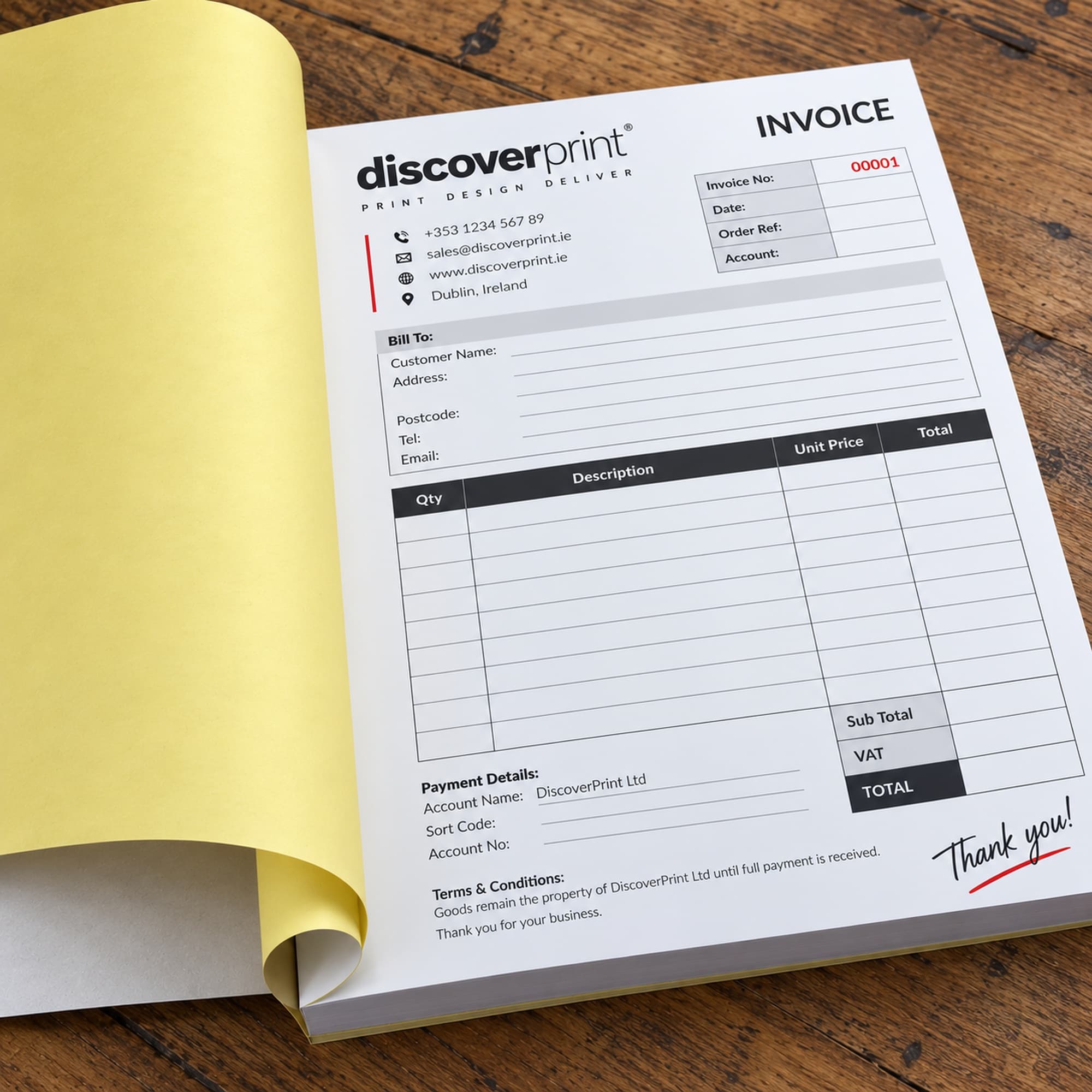
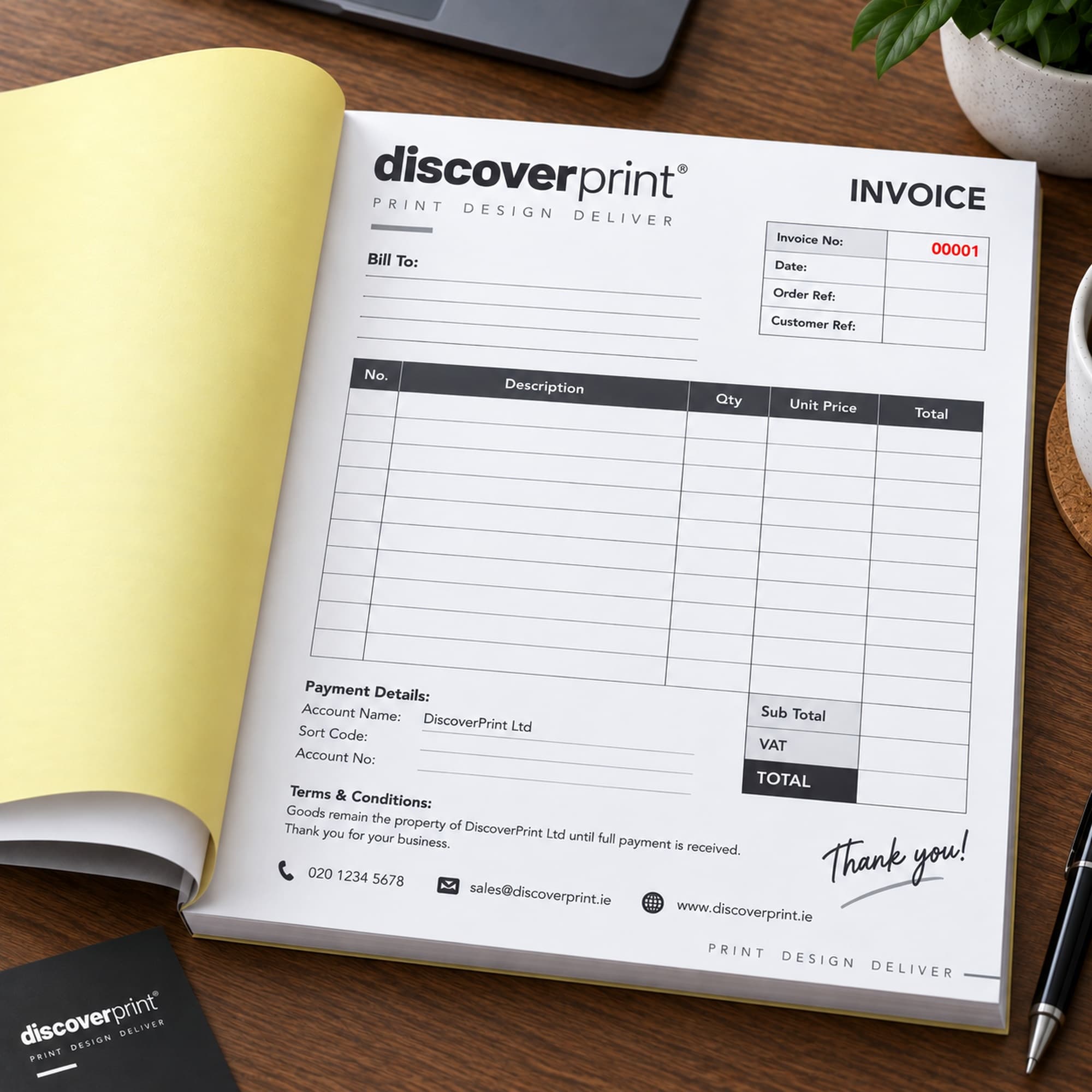
Discoverprint's duplicate invoice books are bound with a manilla cover, a stiff cardboard back and a taped spine, and every set is numbered in sequence, so your retained copies stay together as a complete paper record. With 100 sets in each book, you also have half as many books to store as with 50-set books. Available in A4, A5, A6 and DL, with free design and free delivery anywhere in Ireland. See the full NCR books range.