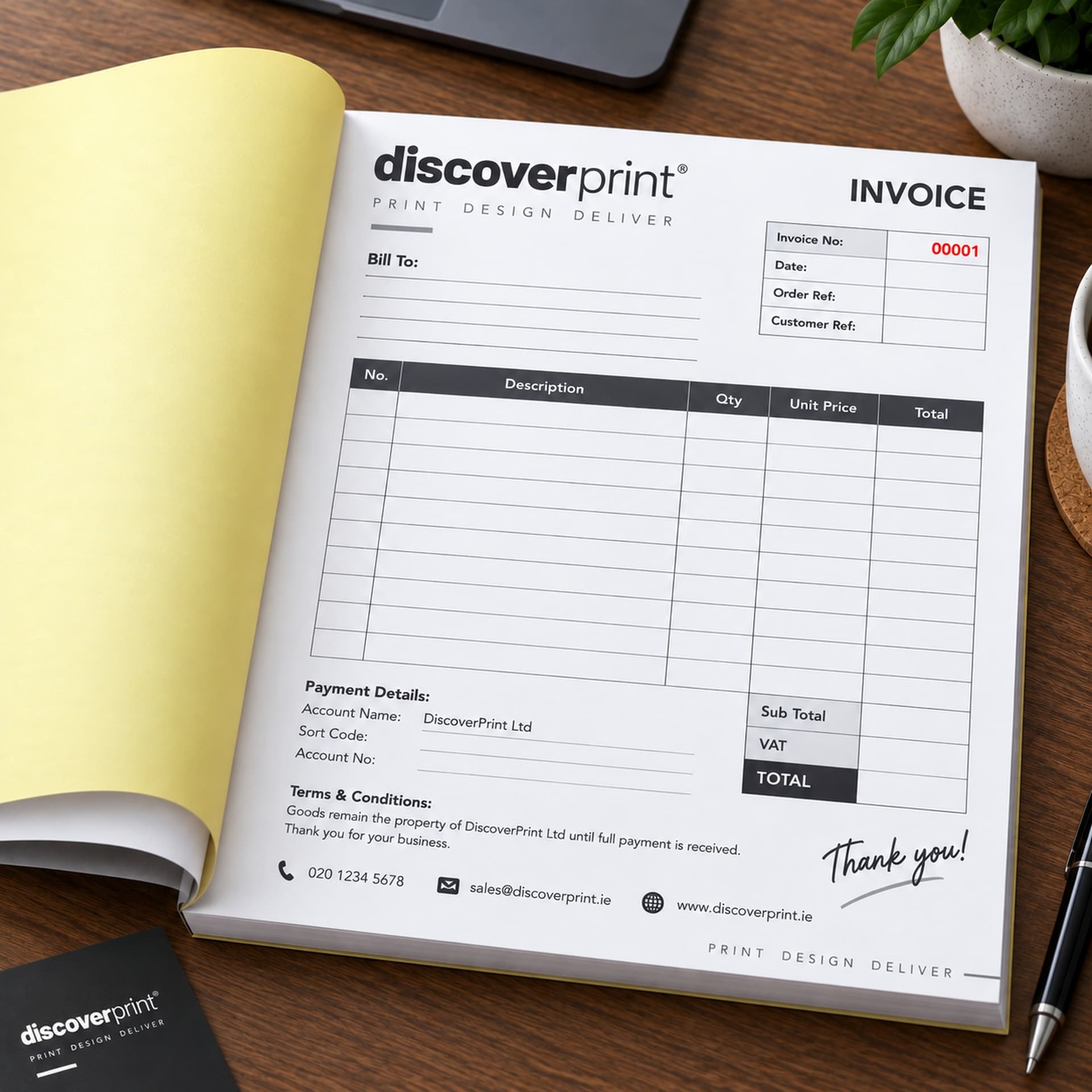
NCR stands for No Carbon Required. It is paper that copies whatever is written on the top sheet onto the sheets underneath, with no sheet of carbon in between and nothing black on your hands afterwards. If you have ever signed for a delivery and been handed the yellow copy, you have used it.
How carbonless paper actually works
The copy is made by two coatings that meet under the pressure of a pen. The back of the top sheet carries microscopic capsules of colourless dye. The front of the sheet below it carries a reactive clay. Press hard enough to write and the capsules under the nib burst, the dye touches the clay, and a mark appears in the same shape as the one you just made.
That is why the sheets in a set are not interchangeable. Printers label them by which side is coated:
- CB, coated back. The top sheet. It gives the copy and never receives one.
- CFB, coated front and back. A middle sheet. It receives the copy from above and passes it on below.
- CF, coated front. The last sheet. It receives a copy and passes nothing on.
A two part set is CB over CF. A three part set is CB, CFB, CF. Put them in the wrong order and the middle of the book stays blank, which is one reason the sheets are usually a different colour: white, yellow and pink tell anyone glancing at the book which copy is which.
Why it replaced carbon paper
Carbon paper worked, but it had to be shuffled between the sheets by hand, it smudged, and it ran out at the worst moment. Carbonless paper was developed in the 1950s by the National Cash Register Company, whose initials the name still carries. Because the copying is built in at the paper mill, a pad can be assembled once at the printer and used straight through to the last set.
Where it is still the right answer
Anywhere someone needs a record and the customer needs one too, at the moment of the job rather than later at a desk. NCR books are used for invoices, receipts, delivery dockets, job sheets, order forms, quotations and service records. Trades use them on site where there is no printer and often no signal. Shops and market traders use them because a handwritten receipt takes five seconds. Anyone who needs a signature on the spot uses them because a signature on the top sheet is a signature on every sheet below it.
The number of parts follows who needs a copy. Two parts when it is you and the customer, which is what a set of duplicate invoice books gives you. Three parts when the office needs one as well.
What gets printed on it
The paper is only half of it. The other half is what is printed on it before you write a word: your logo, your business name, address, phone number, email, VAT number where you need one, your terms on the back, and the ruled boxes that tell whoever fills it in what goes where. A well laid out book is faster to fill in and easier to read back six months later when someone queries an invoice.
Ours are printed to order with all of that set by our designers at no charge. You see a proof before anything is printed, and delivery is free anywhere in Ireland.