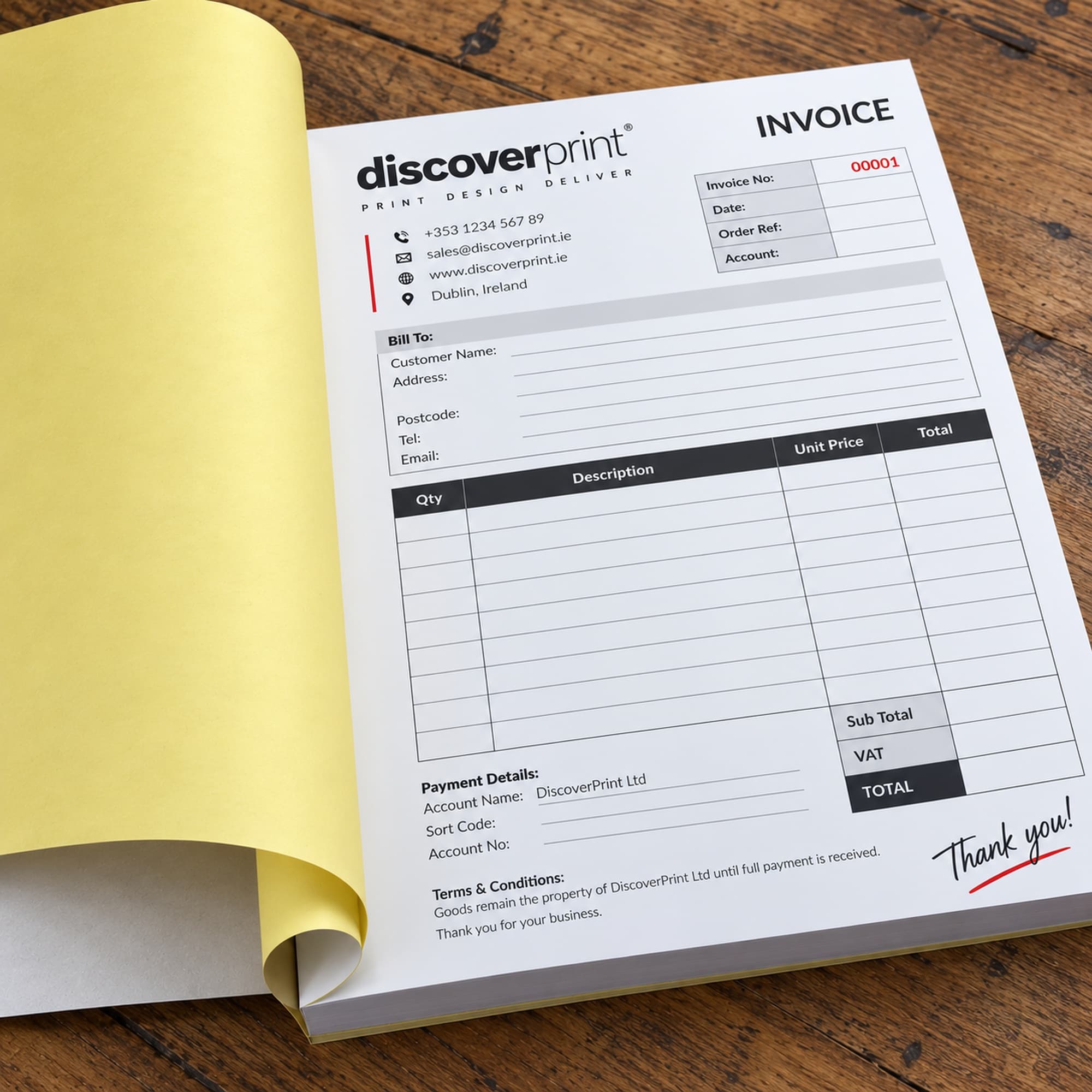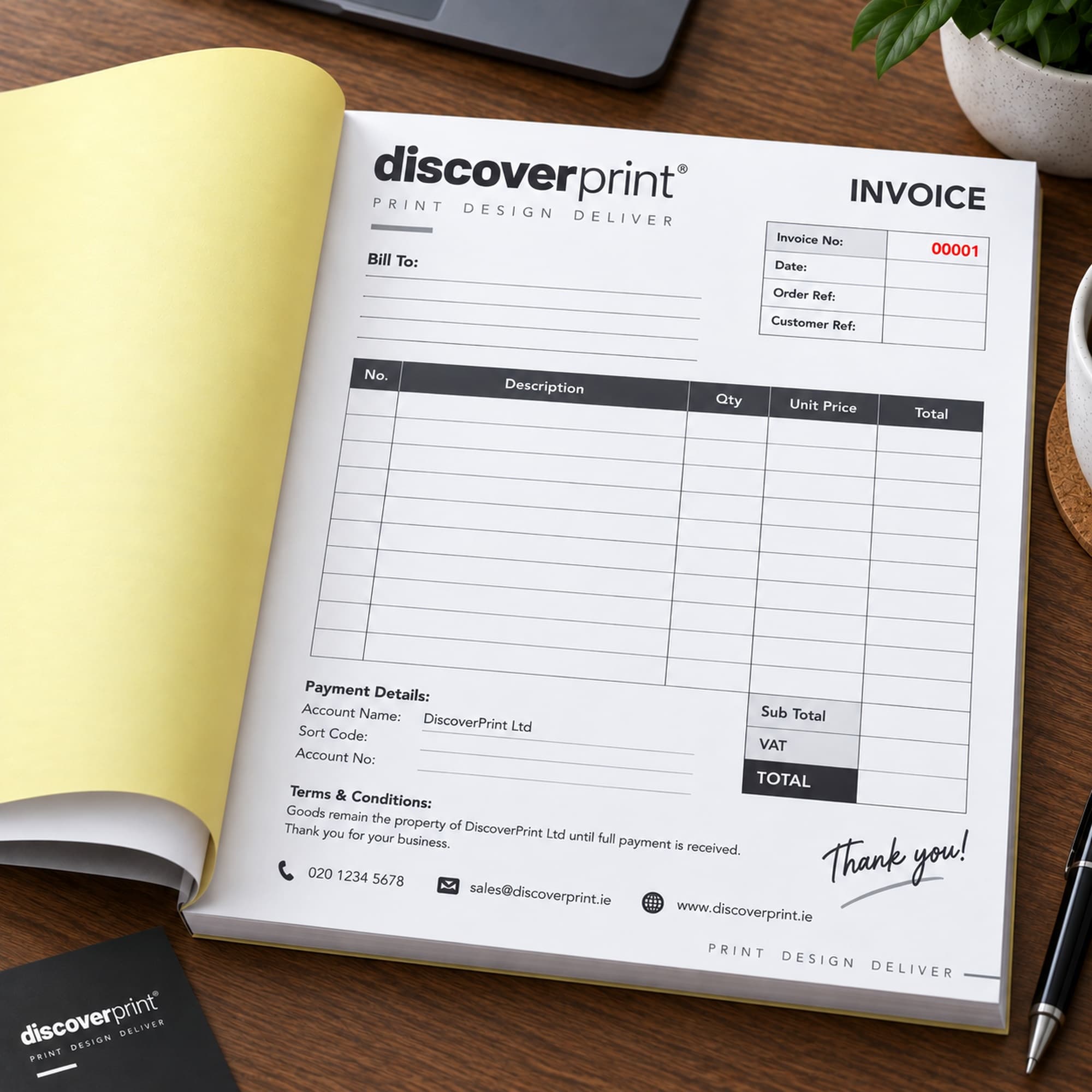
A torn-out page raises one question that nobody can answer a year later: what happened to that invoice number? Here is how to make sure your book always has the answer.
Why a missing number matters
Revenue requires every VAT invoice to carry a unique sequential number. The point of the sequence is that anyone checking your records, whether your accountant or a Revenue auditor, can see that every invoice is accounted for. A gap suggests an invoice that was issued but not recorded. It may be entirely innocent, but you then have to explain it, possibly years later.
A cancelled set that stays in the book is self-explanatory. That is why pre-printed numbering and good habits go together. For background on why numbering matters, see our guide to sequential numbering.
Case 1: the customer has not received the invoice
This covers the usual mistakes: wrong customer, wrong figures, spilled coffee, a pen that ran out halfway.
- Write CANCELLED in large letters across the top copy. It will transfer to the copy below.
- Add the date and a short reason, such as "wrong customer" or "figures incorrect, reissued as 1248".
- Leave the top copy in the book. Do not tear it out, or if it is already torn out, staple it back in at the same place.
- Use the next set for the correct invoice.
That is all. Your accountant will see a cancelled number with an explanation, and the sequence is intact.
Case 2: the customer already has the invoice
Once an invoice has been issued, it is part of your VAT record and the customer's. Revenue's rules for correcting it depend on what went wrong:
| What went wrong | What Revenue requires |
|---|---|
| Price was too high, or a discount was agreed afterwards | Issue a credit note for the reduction |
| Price was too low | Issue a supplementary invoice showing the increase, the VAT rates and VAT, with a cross-reference to the original |
| VAT shown was higher than it should be | You are still liable for the VAT shown. Issue a credit note and a revised invoice |
| VAT shown was lower than it should be | Issue a credit note for the full value, then a revised invoice with the correct VAT |
Revenue says a credit note must be issued within 15 days of the end of the month in which the goods or services were supplied. If you agree a lower price with the customer but the VAT payable does not change, a credit note is not required.
What a VAT credit note must show
- the date of issue and a unique number
- your full name, address and VAT number
- the customer's full name, address and VAT number
- the reason for the credit note
- a cross-reference to the original invoice number
- the amended amount
- the VAT rate or rates that applied when the original invoice was issued, and the VAT at each rate
Businesses that issue credit notes regularly often keep a separate numbered credit note book, so credit notes have their own sequence. It avoids mixing them in the invoice numbering.
Case 3: a page is lost, torn or unreadable
Write a note at that point in the book, on the stub or the next page, explaining what happened, with the date. If it was an issued invoice and your copy is unreadable, ask the customer for a photocopy of theirs and keep it with the book. Faint copies are usually preventable, and How do you fill in an invoice book? covers the pen and pressure habits that stop them.
Habits that prevent most cancelled invoices
- Write the figures in rough first on complicated jobs, then copy them onto the invoice.
- Use one book at a time. Two books in use at once is how numbers get muddled.
- Print the details you always write. The fewer handwritten fields, the fewer mistakes.
Keep cancelled sets with the rest of your records
Cancelled sets are part of the record, and so they are kept for the same period as everything else in the book. How long do you need to keep invoice copies in Ireland? explains the six-year rule and how to store finished books.
Numbered books that keep your sequence intact
Discoverprint's duplicate invoice books are numbered on both parts of every set, so a cancelled invoice stays visible in the book instead of disappearing. When you reorder, give us the next number you need and the new books carry on from there. We can also print a separate numbered credit note book from your own layout. Books come in A4, A5, A6 and DL, with free design and free delivery anywhere in Ireland. See the full NCR books range.