You do not need to know the chemistry to use an invoice book. It does help to know the basics, because it explains why copies come out faint, why sets must be in the right order and why some pens work better than others.
What does NCR stand for?
NCR stands for No Carbon Required. The initials also belong to the National Cash Register company in the United States, which developed and sold the first carbonless copy paper in the 1950s. Printers in Ireland and the UK still say "NCR" out of habit, whatever brand of paper is used. We explain the history in more detail in our earlier guide, What is NCR printing?
How the layers work: CB, CFB and CF
Each sheet in a carbonless set has a job, and the paper mills label them by which side is coated:
| Sheet | Code | Coating | Where it sits |
|---|---|---|---|
| Top copy | CB (coated back) | Ink capsules on the back only | First sheet, the one you write on |
| Middle copy | CFB (coated front and back) | Receiving coating on the front, capsules on the back | Middle of a triplicate or four-part set |
| Bottom copy | CF (coated front) | Receiving coating on the front only | Last sheet in the set |
A duplicate set is a CB sheet on top of a CF sheet. A triplicate set adds a CFB sheet in the middle. The order matters: if the sheets were reversed, the capsules would face away from the receiving coating and nothing would copy. That is why carbonless paper is bought ready-collated by printers, and why sets are glued or bound together in the right sequence.
Why the copy only appears where you press
The capsules are tiny, and they only break under firm, focused pressure, like the tip of a ballpoint pen. Your hand resting on the page is not enough. That is also why the writing shield matters. Without a stiff card under the set you are writing on, the pressure carries through to every set below and leaves faint marks on them. We cover pens, pressure and faint copies in Does NCR paper expire, and why are my copies faint?
Carbon paper versus carbonless paper
Before carbonless paper, copies were made by slipping a loose sheet of carbon paper between two plain sheets. It worked, but carbon paper smudged, marked hands and clothes, and had to be moved to the next set every time. It was also easy to forget, which meant no copy at all.
Carbonless paper removed the loose sheet. The copying layer is part of the paper itself, so every set copies automatically and cleanly. The copy is usually black or dark blue, depending on the paper brand.
Is thermal paper the same as NCR?
No, and the two are easy to confuse because both appear at the point of sale. Thermal paper is the smooth, slightly shiny roll used in card terminals and till printers. It has a heat-sensitive coating, and the printer's print head heats the paper in the shape of the letters. It produces one printout and no copy, and the print can fade quickly in heat or sunlight.
The two also go to different bins. Ireland's national waste guide, mywaste.ie, says thermal receipts are made in more than one layer and treated with chemicals, and it treats them differently from ordinary ink-printed paper. Carbonless paper has its own points to know, which we cover in Is NCR paper recyclable, and is carbonless paper toxic?
What weight is NCR paper?
Carbonless paper for business forms usually weighs roughly 60gsm to 90gsm, close to ordinary 80gsm office paper. The lighter grades let pen pressure reach the bottom copy of a three or four-part set more easily. The NCR pads we print use 82gsm GiroForm carbonless paper, a brand made in Germany by Mitsubishi HiTec Paper. For an explanation of gsm in general, see our guide to paper weight.
Can you print on NCR paper yourself?
You can, with the right paper and the right printer, but it is not as simple as loading it in the office machine. We explain the risks and when it makes sense in Can you print on NCR paper with a laser or inkjet printer?
How Discoverprint prints NCR books
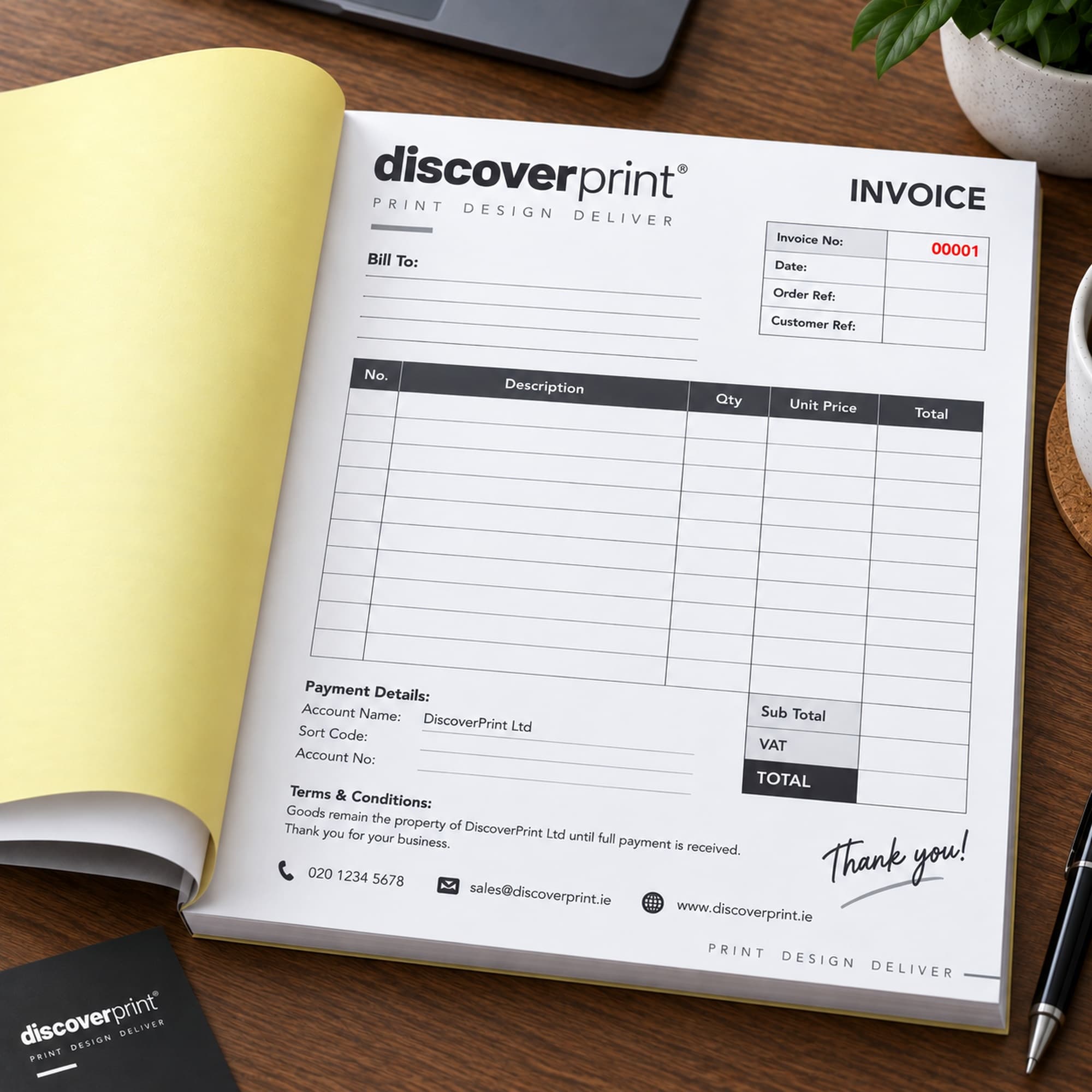
Every book we print is carbonless, collated in the right order for its part count, numbered on every part of every set and bound with a manilla cover, a cardboard back and a wrap-around writing shield. Our personalised invoice books come in A4, A5, A6 and DL, with 100 sets in a duplicate book or 50 sets in a triplicate book, and the design is free. The full range, including books printed from your own file, is on our NCR books page.