This question comes up more than you might expect, usually from someone who has read an old warning online or who handles hundreds of forms a day. Here is what is known, and what it means for a business in Ireland.
Why did carbonless paper have a bad reputation?
Carbonless paper works by trapping ink inside microscopic capsules on the back of each sheet. In the early years, the liquid used to dissolve that ink contained polychlorinated biphenyls, or PCBs. PCBs were used widely in industry at the time because they are very stable. That stability turned out to be the problem: they do not break down, they build up in the environment, and they were later linked to health risks.
Archivists still flag old carbonless forms from that era as a handling concern. The use of PCBs in carbonless paper was stopped in the early 1970s, and in the United States the paper industry's PCB problem was traced mainly to recycled carbonless paper made between 1957 and 1971. None of the carbonless paper sold today is made that way.
Is modern carbonless paper safe to handle?
For normal use, yes. Modern carbonless papers use different solvents and dyes. Research summaries report that some people handling very large quantities of older carbonless paper in badly ventilated offices had mild skin or eye irritation, and that a 2000 review found no irritation or sensitisation from carbonless paper made after 1987.
As with many coated papers, a small number of people with sensitive skin may react to the dyes. If you handle forms all day, the ordinary advice applies: keep the room ventilated, wash your hands before eating and do not rub your eyes after sorting a large stack.
Is NCR paper the same as thermal till receipts?
No. They are often lumped together because both turn up at the point of sale, but they are different products. Thermal paper, used in card terminals and till printers, darkens when heated. Carbonless paper reacts to pressure. We explain the difference in How does NCR paper work, and is it the same as carbonless or thermal paper?
They are also treated differently in the bin. Ireland's national waste guide, mywaste.ie, says that shiny thermal receipts are made in more than one layer and treated with chemicals, and it advises putting most of them in general waste. Only receipts printed with ink on plain, rough paper can go in the recycling bin.
Can you recycle NCR paper in Ireland?
Carbonless paper is paper with coatings on one or both sides. Some collectors take it with office paper and some prefer it in general waste, so the only reliable answer is your own collector's list. If it does not mention carbonless or NCR paper, ask them.
Two practical points matter more than the bin colour:
- Shred first. Invoice copies carry customer names, addresses and often payment details. Data protection law expects personal data to be disposed of securely, so do not put them in any bin intact. Shredded paper is accepted by many collectors in a paper bag or as part of a confidential shredding service.
- Remove covers and staples if your collector asks for clean paper. The cardboard backs of invoice books can usually go in with cardboard.
When can you get rid of old invoice books?
Not yet, in most cases. Revenue generally expects business records to be kept for six years from the date of the latest transaction they relate to, and longer if a period is under enquiry, investigation or appeal. It also asks that invoices issued on paper are kept in paper form, and that paper records are kept within the State.
So the book you finished last month is part of your records until at least six years after the last invoice in it. Our guide How long do you need to keep invoice copies in Ireland? covers the rules in full, and Does NCR paper expire, and why are my copies faint? explains how to store old books so the copies are still readable when you need them.
Is there a greener way to use NCR books?
The biggest saving is simply wasting fewer books. A few habits help:
- Choose duplicate rather than triplicate unless the third copy genuinely has somewhere to go. Every unused copy is paper you paid for and will later shred.
- Order the right size. An A4 book used for two-line invoices wastes most of every page.
- Order a sensible quantity, so spare books do not age in a cupboard for years.
Order books that last longer between orders
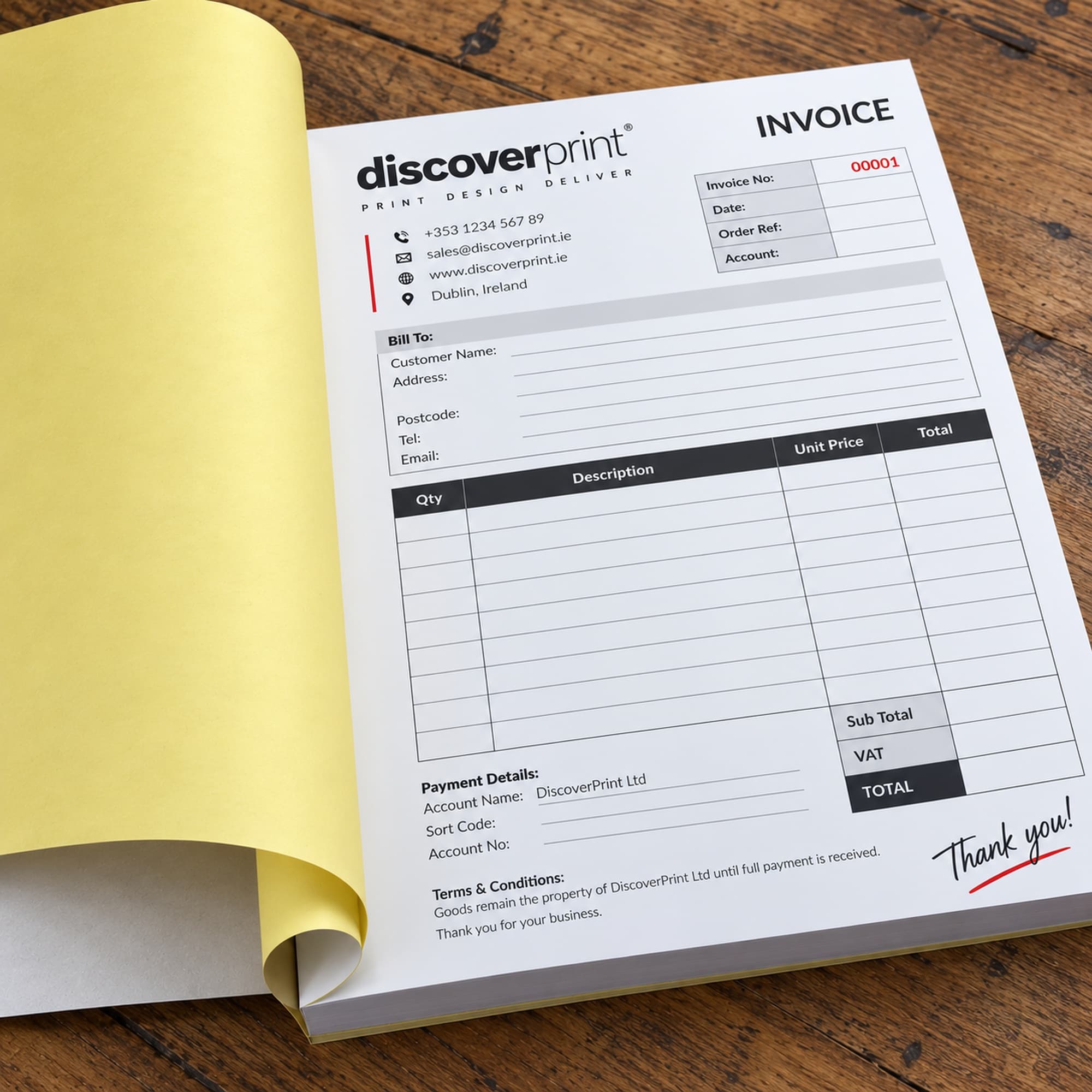
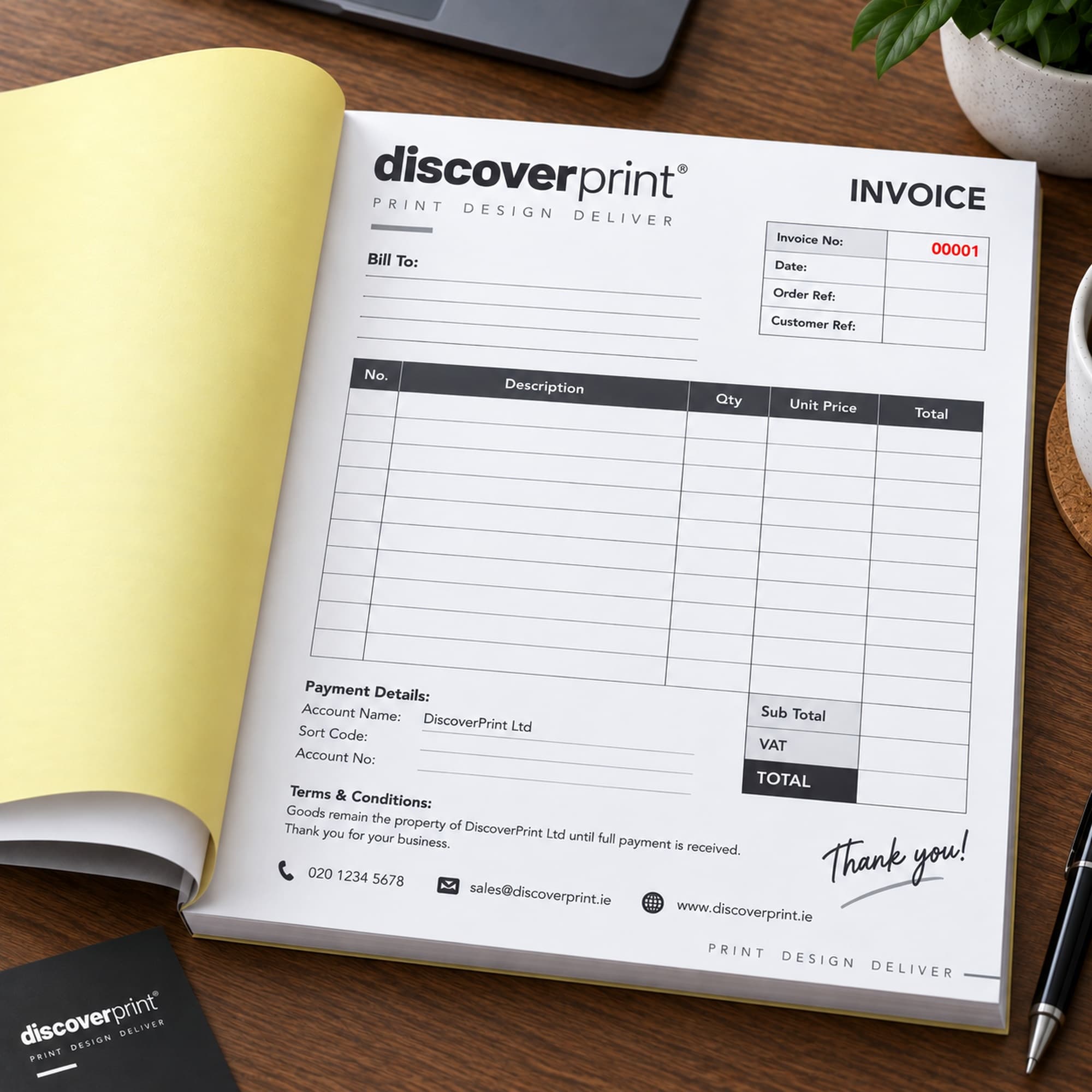
Many suppliers bind 50 sets in a duplicate book. Discoverprint's duplicate invoice books hold 100 sets each, 200 sheets, so one book lasts twice as long, with fewer covers and backing boards along the way. They come in A4, A5, A6 and DL, numbered on every part, with free design and free delivery anywhere in Ireland. See the full NCR books range for other options.