Whether you are a plumber, an electrician, a landscaper, a cleaner or a mobile mechanic, the question is the same: what do I actually need on the form? The answer depends on two things: your VAT status and the name you trade under.
Step 1: know your VAT status
The VAT registration thresholds for a business established in Ireland are based on turnover in any continuous 12-month period:
| What you supply | Threshold |
|---|---|
| Services | €42,500 |
| Goods, or goods and services where at least 90% of turnover is from goods | €85,000 |
Below the threshold, registration is optional. Some sole traders register voluntarily because most of their customers are VAT-registered businesses that can reclaim the VAT, or because they want to reclaim VAT on their own costs. That is a decision to make with your accountant, not your printer. What matters for your invoice book is which layout you need.
Step 2: know your trading name
Under the Registration of Business Names Act 1963, an individual must register with the Companies Registration Office if they trade under a name that is not their own surname. The CRO gives a clear example: John Murphy trading as "Murphy Builders" must register, but John Murphy trading as "Murphy" or "John Murphy" does not.
If you do trade under a registered business name, the Act also says your business letters, circulars and catalogues that show the business name must also show your own first name or initials and surname. Many sole traders print "John Murphy t/a Murphy Builders" in the header of their invoices for that reason. It also makes it clear to customers exactly who they are paying.
What a non-VAT sole trader invoice should show
- your name, or your name and registered business name, and your address
- your phone number and email
- a unique invoice number, in sequence
- the date
- the customer's name and address
- a clear description of the work or goods, with quantities
- the amount for each line and the total due
- how and when to pay, including your bank details
Leave the VAT lines off completely. A form with an empty "VAT" box invites questions, and writing "0%" in it is wrong because you are not charging VAT at all. Some sole traders add a short line such as "Not registered for VAT" so business customers do not ask.
What changes once you register for VAT
Once registered, you must issue a VAT invoice when you supply another VAT-registered business, a government department, a local authority or a statutory body, a business carrying on an exempt activity, or a business in another EU country. A VAT invoice needs more detail, including your VAT number, the price before VAT, a breakdown by VAT rate and the total VAT. The full list is in Are handwritten invoices legal in Ireland?
This is the point at which many sole traders reorder their invoice books, because the old form has nowhere to write the VAT. Do not try to squeeze it in by hand on a non-VAT form. Order a new book with the VAT lines laid out properly, and start a new number sequence or carry on the old one, whichever your accountant prefers.
Keeping records as a sole trader
Every self-employed person in Ireland must keep records that support their tax return, VAT registered or not. The copies in your invoice book are part of that record. Keep finished books together, in order, somewhere dry. Revenue generally expects records to be kept for six years. We explain how in How long do you need to keep invoice copies in Ireland?
Getting paid on time
An invoice is only half the job. Printing clear payment terms on every invoice, such as "Payment due within 14 days" and your IBAN, makes it far easier to chase a late payer. If your customers are businesses, Irish late payment law also gives you rights to interest and compensation. Read How long does a customer have to pay an invoice in Ireland? before you settle on the wording.
Paper or software?
Invoicing apps suit some sole traders well, particularly those who invoice in batches at the end of the week. A paper book suits those who want to hand the customer an invoice before they leave the job, with no phone signal or battery needed. Plenty of sole traders do both: a paper invoice on site, entered in bookkeeping software later. Both are valid, as long as the invoice itself carries the right details. If you are filling in your first book, How do you fill in an invoice book? walks through it box by box.
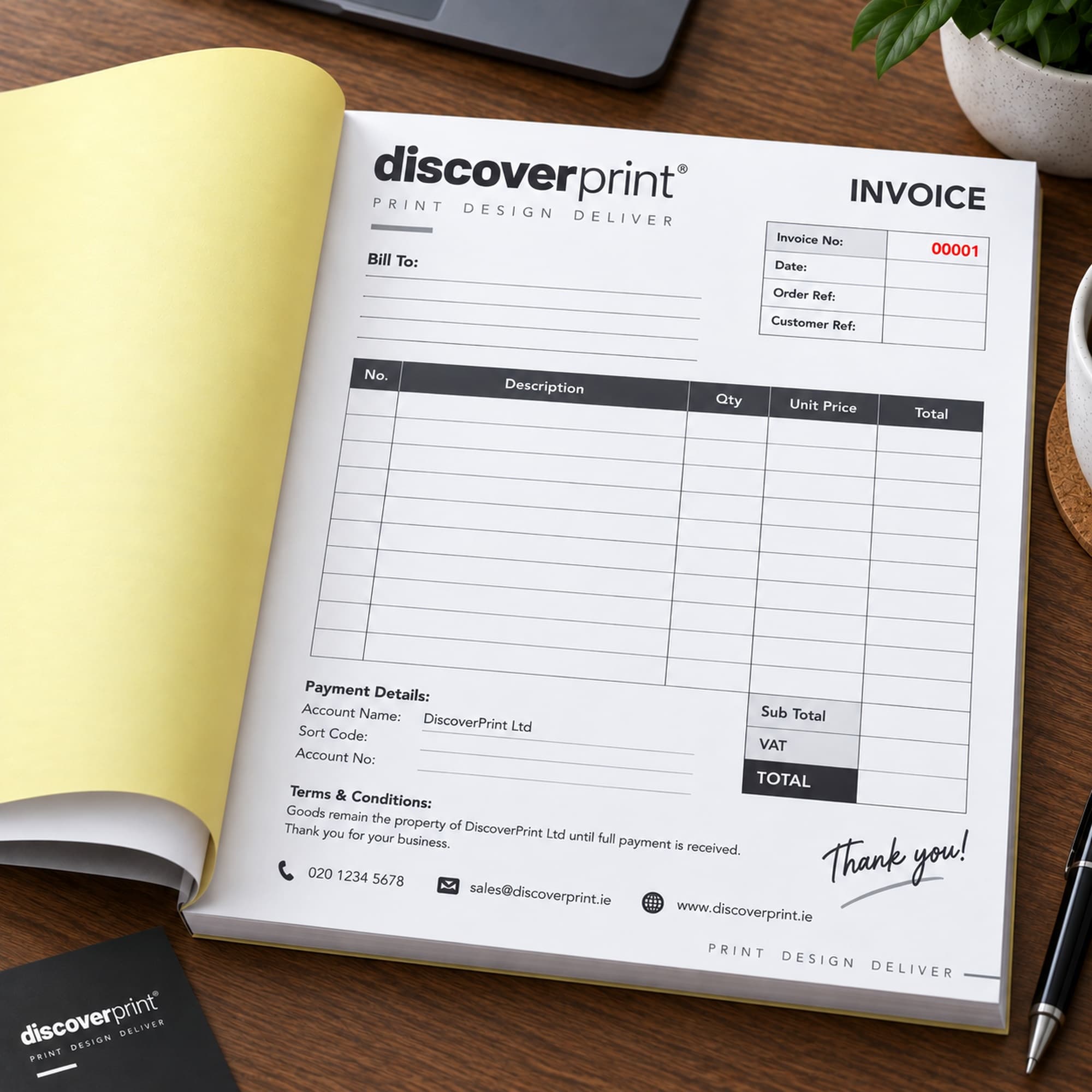
Invoice books for sole traders, with or without VAT lines
Discoverprint's personalised invoice books can be laid out with or without VAT lines, with your name, trading name, address, bank details and payment terms printed in the header, and sequential numbers from any starting number. The emailed proof shows exactly what will print before anything goes to press. A5 is the size most sole traders choose. Design is free and delivery is free anywhere in Ireland. See the full NCR books range.