Few small businesses use these rights, partly because they do not know about them and partly because nobody wants to fall out with a good customer. But clear payment terms printed on every invoice make the conversation much easier when you do need to have it.
Where do the rules come from?
The EU Late Payment Directive was brought in under Irish law by S.I. No. 580 of 2012, which applies to contracts made from 16 March 2013. It covers commercial transactions, meaning sales of goods or services between businesses, or between a business and a public authority. The Department of Enterprise, Tourism and Employment is responsible for the rules and publishes the interest rate.
The payment deadlines
| Who is paying | Deadline |
|---|---|
| A business, where no date was agreed | 30 days |
| A business, with agreed terms | The agreed date. Over 60 days must be expressly agreed and not grossly unfair to the supplier |
| A public authority | 30 days as standard |
"Expressly agreed" means it was actually agreed, not buried in small print you never saw. If a large customer imposes 90-day terms on you in a way that is grossly unfair, the regulations give you grounds to challenge it.
Statutory interest: how much and how to calculate it
When a business pays late, you are automatically entitled to interest from the day after the deadline, without having to send a reminder first. The rate is the European Central Bank's main refinancing rate plus 8 percentage points. The ECB rate on 1 January and 1 July sets the rate for the following six months. From 1 July 2026 it is 10.4% a year.
Interest is calculated daily. The formula gov.ie gives is: the amount owed, multiplied by the number of days late, multiplied by the daily rate.
Example: a €2,000 invoice paid 45 days late.
- Daily rate: 10.4% divided by 365 = 0.0285%
- Interest: €2,000 x 45 x 0.000285 = about €25.64
- Plus fixed compensation for a debt between €1,000 and €10,000: €70
Fixed compensation for late payment
On top of interest, you are entitled to a fixed sum to cover the cost of chasing the debt:
| Size of the debt | Compensation |
|---|---|
| Under €1,000 | €40 |
| €1,000 to €10,000 | €70 |
| Over €10,000 | €100 |
You can also claim reasonable recovery costs above those amounts, such as legal fees, where you can show them.
How to claim it
gov.ie advises that you should not issue an invoice for late payment interest and compensation. Instead, write to the customer, explain that the payment is late and that you are now seeking late payment interest and compensation under the regulations. You do not need to have mentioned the rules in your contract beforehand.
What payment terms should you print on your invoices?
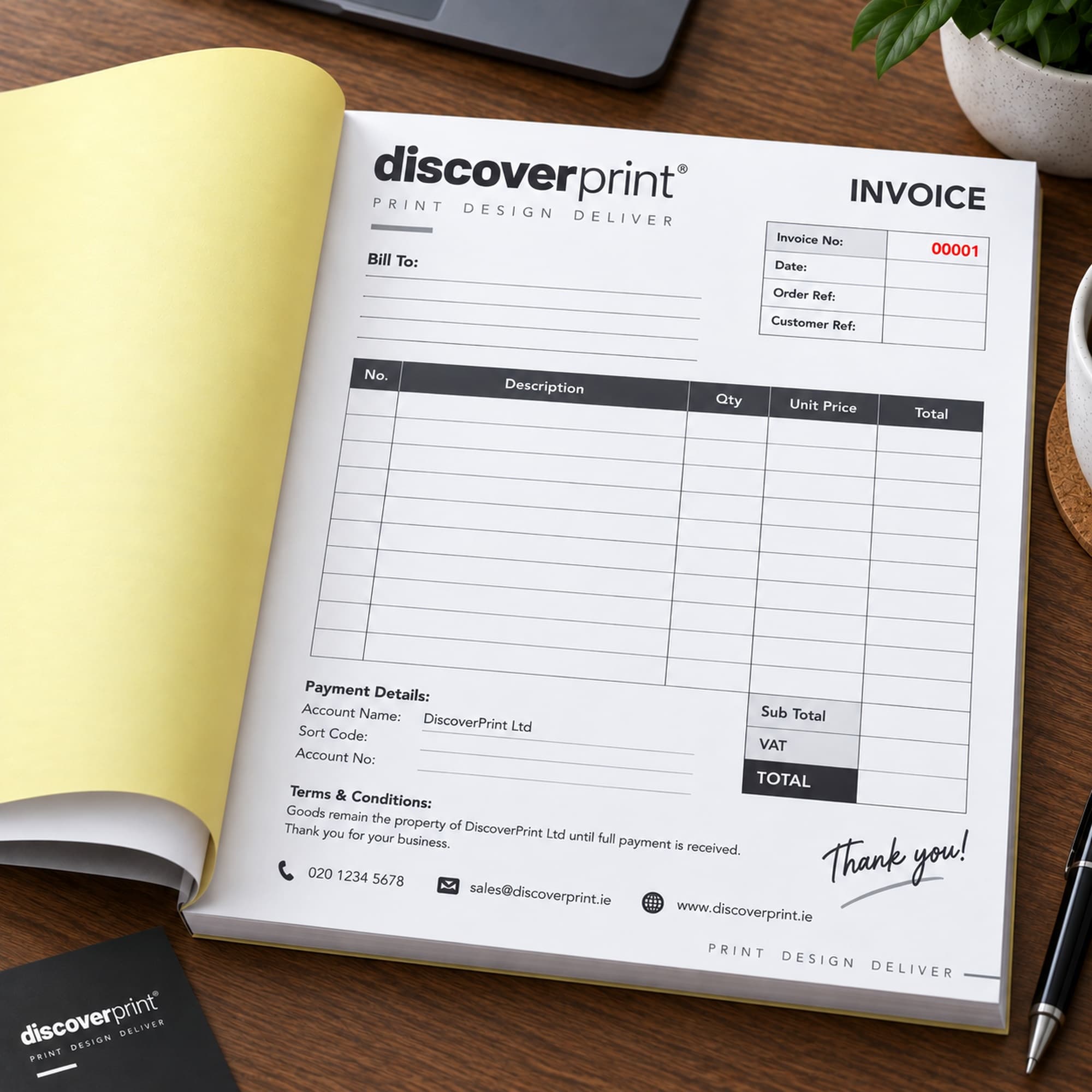
The law gives you a fallback. Printed terms remove the doubt. We suggest every invoice form shows:
- The due date or period. For example "Payment due within 14 days of invoice date" or "Payment due on completion".
- How to pay. IBAN and BIC, and any other methods you accept.
- A reference. "Please quote the invoice number with your payment."
- For business customers, the late payment line. For example "Late payments may incur interest and compensation under the European Communities (Late Payment in Commercial Transactions) Regulations 2012."
For private customers the regulations do not apply, so keep the wording to the due date and how to pay. If you want a deposit before starting work, say so on your quote, not just on the invoice. Our guide What is the difference between a quote, an estimate and an invoice? explains why the quote matters.
Other habits that get invoices paid faster
- Invoice on the day. A handwritten invoice handed over at the end of the job is not waiting in an outbox.
- Get the name right. Invoices to a company's full legal name and address are harder to lose in an accounts department.
- Keep the copy readable. If a customer disputes an invoice, your retained copy is your evidence.
If you are a sole trader setting up your first book, How do you invoice as a sole trader in Ireland? covers the rest of the layout, and How do you fill in an invoice book? covers the writing.
Payment terms printed on every invoice
Discoverprint can print your payment terms, IBAN and BIC and a late payment line on every page of your personalised invoice books, as part of the free design service. Books come in A4, A5, A6 and DL, duplicate or triplicate, numbered in sequence, with free delivery anywhere in Ireland. See the full NCR books range.